
More than a decade ago, while I was chair of Ofqual, the exam regulator, I spent a few days visiting ultra-low cost private schools in Uganda with a small group that included a lovely and thoughtful man named Peter Martin. He was a secondary English expert, and had been deeply involved in the DfE National Strategies work some years earlier. We had fascinating conversations in the evenings about what we were seeing and also about education more generally.
In one of those conversations he told me how uncomfortable he was about the then planned changes to English Language GCSE, and in particular some of the assessment changes. One change was to remove written coursework (controlled assessments) entirely. And while a graded speaking and listening assessment was to be retained, the grading was simplified and the grade would no longer count towards the overall GCSE grade.
I explained the rationale to him. Despite the good intentions of the qualification’s designers, most pupils were not getting a good classroom experience. Many were taught narrowly to the specific assessment tasks, and often taught quite reductively: “you need to get this many marks for your target grade, this is how the mark scheme works, you will keep redoing the task until you get the right number of marks”. This was mind-numbingly boring for adults and children alike. And it also meant that coursework marks often bore little relation to a pupil’s likely performance in a future task for which they had not been intensively coached. Exam boards were able to moderate the marks teachers gave to pieces of coursework, but they could not moderate the process by which they had been achieved to compensate for this.
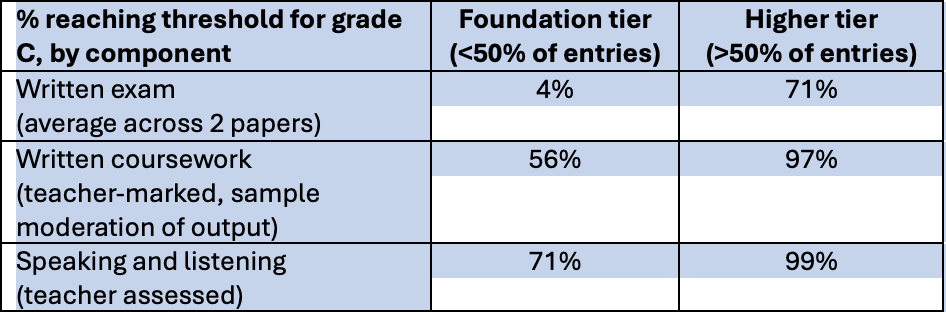
The problem was even more acute for speaking and listening. There was no practicable way of moderating teachers’ assessments, and direct external assessment of the entire year group would have been prohibitively expensive. It was an open secret that teacher marks for speaking and listening were extraordinarily high relative to pupils’ marks in the externally marked exams. For example, in 2011, more than 70% of foundation tier GCSE entrants reached the grade C threshold for speaking and listening. But of those same pupils, only 4% reached that threshold on the written exam.[1]
On that warm evening in Kampala, Peter Martin listened to me, but it was obvious that he couldn’t square what I was saying with his experience from pilots, in which children had had a broad educational experience and produced work that fairly reflected their accomplishments. He was deeply sceptical that the changes were a good thing, and I failed to convince him.
But back in England some weeks later, Peter and I met again. And it transpired that in between, he had had a long meeting with the head of English at the school where he was chair of governors. He had been taken through their secondary English model: both what they taught and how they approached the assessments. I can still remember his first words when he came up to me: “you were absolutely right”. He went on to tell me that how the coursework and teacher assessed elements were being handled in that school bore little relation to what had been intended or expected.
But I was not surprised: given the high stakes nature of English Language GCSE for both schools and pupils, schools that entirely resisted the pressure to distort curriculum and teaching were, sadly, the exception not the norm. People who work in schools are humans like everyone else, and respond just as strongly to incentives, whether well- or poorly designed. And at least three pressures were operating on schools and those working in them to bend GCSE English out of shape.
One pressure was simply to ensure that the school’s pupils achieved highly. This is of course a good aim, but for the grades to be meaningful, they should be a fair reflection of the pupil’s knowledge and skills, not an artefact of the school’s expertise in teaching children how to collect marks in assessments.
Linked to this, I was often told about ‘the school down the road’ – a head of English might know that their approach was not education as it should be, but fear of appearing to be less successful than other local schools often made them reluctant to move away from reductive models.
Beyond this, teachers often told me that by making sure that pupils achieved certain grades, they were improving their ‘life chances’. Thus reductive teaching and gaming became morally unimpeachable: you could tell yourself you were doing the right thing for disadvantaged children.
And yes, a 16 year old with higher GCSE grades has more choices at that point. But grade requirements are not arbitrary: they are intended to make sure that students embarking on a course have a reasonable likelihood of succeeding on it. A student who only qualifies for a course because their GCSE grade overstates their true achievement, and who has experienced a narrowed curriculum, is more likely to struggle and drop out. Not so good for their life chances.
The conclusion from Ofqual’s work was unavoidable - building written coursework and “speaking & listening” into high-stakes assessments worsened children’s educational experience, distorted school priorities and also devalued the qualifications and the grades those pupils received. Reform was absolutely necessary.
The final point is that this all happened out of the public eye. It was a dirty secret in the school sector – many people knew what was happening, but it was in no-one’s interest to air it. Governors and even headteachers were often unaware of how schools were actually approaching GCSEs. When Ofqual published its English GCSE final report in 2012, the serious issues it raised about how schools were approaching assessments were swiftly allowed to fall from view.
And now we have a Labour government that seems not to have understood any of these mistakes of the past. Lucy Powell is trumpeting oracy (the fashionable new branding of “speaking and listening” and signalling her intention to build oracy into school assessments, apparently oblivious to all that is likely to go wrong.
Her announcement relies on a straw man, insofar as it plainly implies that spoken language did not previously feature as a curriculum strand. In fact, the aims of the 2014 national curriculum for English say that children should “use discussion in order to learn; they should be able to elaborate and explain clearly their understanding and ideas” and become “competent in the arts of speaking and listening, making formal presentations, demonstrating to others and participating in debate”. And there is a clearly delineated Spoken Language strand which actually appears ahead of the Reading and Writing strands.
Similarly Powell’s remarks reported in today’s Guardian are disingenuous to say the least: ‘I do not accept a two-tier system where confident communication is seen as essential for children whose parents can afford school fees, but optional for everyone else.’[2] But no-one, literally no-one, has argued this, or at least not in this century. Characterising principled objections as snobbery is a cheap tactic.
A number of excellent education experts, such as David Didau in a recent Substack[3], have been unpicking the real problems with the oracy narrative. A fundamental point they make is that oracy is not and should not be treated as a free-floating generic skill that stands apart from building a child’s knowledge and capacity to apply it. The more we know about a topic, the more easily we can construct and present an argument about it, and so schools’ efforts should still be mainly directed at building valuable knowledge. Society does not gain from those with wonderful oracy but little knowledge, who convince others with their misconceptions, nor from silver-tongued conmen who set out to deceive.
The cardinal error of the 2009 National Curriculum was to lead with generic skills and to treat substantive knowledge as incidental stuff that might be helpful in skill-building. Powell’s oracy announcement looks worryingly like a first step in the direction of a move back to a skills-oriented curriculum, in the teeth of all the evidence from international studies such as PISA and from the natural experiment of the last fifteen years as between England, Scotland and Wales.
So what should we do, if we want to be sure that schools are doing all they should to teach children to apply knowledge orally, but without recreating these problems of the past? If direct assessment is unlikely to succeed, as Bodil Isaksen suspects[4], inspection is the other obvious lever. Proper periodic scrutiny of a school’s curriculum and teaching could help ensure that all children are getting the full intended curriculum including plenty of opportunities to apply knowledge orally. But the government has already moved in the opposite direction, with subject-level scrutiny removed from inspection within months of its being elected. Thus government has blinded itself to the distortions that can arise when ministerial aspirations do not translate in the real world.
So here we are again. It’s Groundhog Day, everyone.
+ + + + + + + + + + + + + + + +
To show how outcomes from other forms of assessment can diverge from exam grades, to a degree that should give any responsible minister pause for thought, here are some stats for English Language GCSE in 2011. These are for AQA, which had the biggest entry in that subject. Data is taken from Ofqual’s final report on the problems with English Language GCSE in 2012[5]:
[1] See the table at the end of this post
[2] https://www.theguardian.com/commentisfree/2026/oct/19/young-people-speak-fluently-oracy-skills-pupils-schools

https://lnkd.in/p/eFjXDJjn
[5] https://dera.ioe.ac.uk/id/eprint/15875/1/2012-11-02-gcse-english-final-report-and-appendices.pdf, page 51
I remember a colleague asking SLT what to do about the speaking and listening assessment with a student who was an elective mute.
“Give him the grade you think he’d get if he did speak,” came the reply.
Great piece. Those of us who were teaching English then remember what it was like!